
More Unity, Security and Strategic Autonomy at Competitive EU POLITICO Summit
Europe’s economic and political future took centre stage today as high-level policymakers, industry leaders and thinkers gathered at the POLITICO Competitiveness Summit.
Against a backdrop of slowing growth, geopolitical turbulence, and an accelerating global technology race, participants delivered unusually frank assessments of Europe’s vulnerabilities, as well as its capacity to adapt and lead.
The day opened with a reminder that the European project was built to offer stability and prosperity but now faces a moment of reckoning.
Speakers acknowledged that “for years, Brussels saw itself as a beacon of a world order that’s crumbling,” and argued that this requires a new, pragmatic vision able to withstand both geopolitical pressure and technological upheaval.
The call to rethink Europe’s growth model ran through the debates, reflecting the sense that the continent’s previous incrementalism is no longer enough.

Technology and artificial intelligence dominated the morning. Experts presented striking figures: while nearly all Chinese companies are already integrating generative AI, only a small fraction of European firms have done so.
Corporate voices from the technology sector urged legislators to focus on clear, smart, and internationally aligned rules that protect users without stifling Europe’s own capacity to invent.
At the same time, there was a call to invest heavily in digital skills and adoption to avoid watching innovation happen elsewhere while European businesses fall behind.
The sense of impatience deepened when the conversation turned to the economic reform agenda set out a year ago by Mario Draghi. His competitiveness blueprint had been heralded as a turning point, but participants admitted that only a fraction of its key recommendations have been realised.
Only 11% of Mario Drapghi‘s recommendations have been implemented.
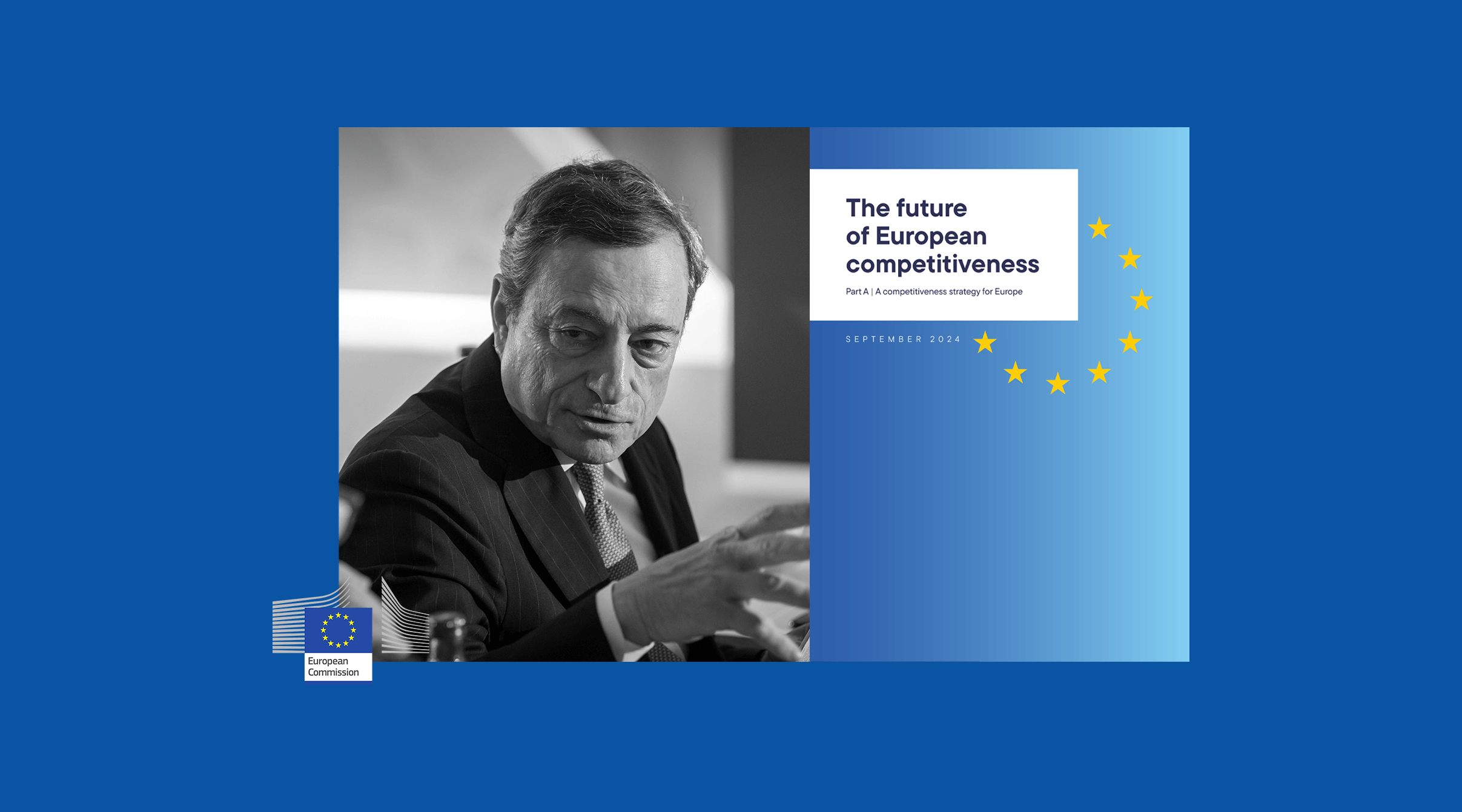
Read the full article: Europe needs leadership, Artificial Intelligence, and social inclusion [+]
Many warned that hesitation is feeding political frustration and weakening Europe’s industrial base.
The cost of inaction is no longer theoretical but measured in lost investment, declining productivity and a dangerous erosion of trust in the European project itself.
Energy policy emerged as one of the sharpest dividing lines between aspiration and delivery. Industrial leaders insisted that the price and stability of energy supply are decisive for investment decisions, and that Europe still lacks a true single energy market capable of lowering costs and unlocking the full potential of renewables and nuclear power across borders.
Achieving an integrated European Energy Union would do more to strengthen competitiveness than any number of policy declarations.
Trade and industrial policy debates were equally intense. The notion of “open strategic autonomy” was examined from multiple angles, with some urging Europe to reduce its exposure to fragile supply chains without retreating into protectionism.
Senior business voices cautioned against turning inward and undermining ties with dynamic markets in Asia, Africa and Latin America. Yet there was broad agreement that Europe must be indispensable in global value chains if it is to shape the terms of trade and innovation.
Geopolitics and security were never far from the surface. Ukraine’s Deputy Prime Minister underlined how deeply his country is already embedded in European supply chains, from steel to energy, and called on the Union to view Ukraine as a partner rather than a competitor.
Members of the European Parliament, including David McAllister, argued that a credible European Defence Union is needed by the end of the decade if the continent is to remain secure and sovereign.
German and Danish representatives spoke of an historic shift in mindset on defence spending but warned that speed and coordination remain elusive.
The rise of drone warfare and cyber threats was presented as an opportunity for Europe to leap ahead technologically — but only if political will keeps pace with events.
The most potent undercurrent of the day was frustration with slow delivery.

Energy, technology and defence were repeatedly cited as areas where delay is no longer an option.
For managers and leaders, one of the main takeaways from the first day of the Summit is that Europe still possesses immense strengths, talent, technology, and a market with unmatched potential, but the space for hesitation is gone.
Investing in skills and engaging proactively with policymakers to shape the next phase of integration rather than waiting for it to arrive is urgent, and managers are the bridge-builders who can make this possible.
Europe remains capable of leadership, but only if it finds the courage to move from vision to action before the window to act closes.
More information on the POLITICO Summit can be found here [+]

