
Europe’s Crossroads: What Ursula von der Leyen’s State of the Union Means for Managers
Europe stands at a crossroads, defending its independence, competitiveness, and unique social market economy, says Ursula Von der Leyen, President of the European Commission.
This sentiment could summarize what she set out in her 2025 State of the Union (SOTEU) address.
CEC European Managers, as one of the six EU Social Partners, wants to add that “Now is the time for managers to lead the way — championing sustainability, innovation, and the European values that make our model worth protecting.”
A Call for Social and Economic Balance
Von der Leyen acknowledged what millions of Europeans feel: higher prices, social uncertainty, and a world that seems less stable.
She made it clear that Europe’s economic strength must be underpinned by a strong social dimension — not as a luxury, but as the foundation for competitiveness, innovation, and resilience.
CEC European Managers agrees that economic and social agendas are no longer separate and that European Pillar of Social Rights was reaffirmed as the compass for policymaking, with commitments to decent working conditions, skills development, inclusion and the promise to tackle the housing crisis — areas where managerial leadership is crucial.
The European Pillar of Social Rights
What is the European Pillar of Social Rights, and why everybody mentions it when discussing Employment and Social Affairs?
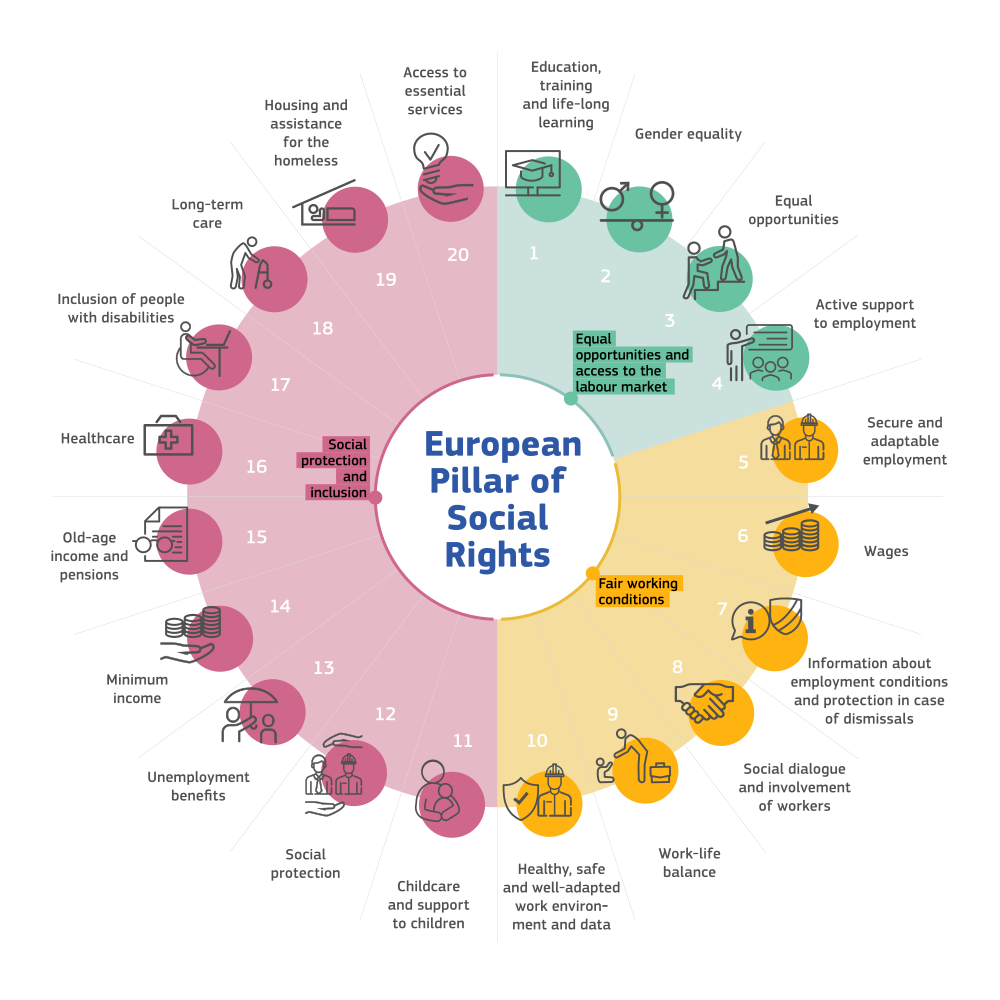
The EU Pillar of Social Rights consists of 20 principles launched by the European Commission together with the EU social partners which are the beacon guiding the EU towards a strong social Europe that is fair, inclusive and full of opportunity.
Until today, the European Commission has already presented several actions based on each principle of the Pillar, with additional actions planned to further strengthen social rights in the EU.
With the so-called European Pillar of Social Rights Action Plan, the Commission has set out concrete initiatives to deliver on the European Pillar of Social Rights.
The delivery on the Pillar is a joint effort by EU institutions, national, regional and local authorities, social partners and civil society.
Competitiveness Meets Social Market Economy
The European “social market economy” is a framework that combines free market capitalism with strong social policies: ensuring fairness, social protection, labour rights, access to public services, equality, etc.
In von der Leyen’s speech, the social market economy was presented as one of Europe’s strengths.
We have everything it takes to thrive here in Europe – from our Single Market to our social market economy.
This social approach towards economy and growth must coexist with competitiveness, and is part of the “package that Europe offers“.
CEC European Managers also believes that Europe’s social model should be treated not as cost or burden, but as an asset – in terms of stability, inclusion, legitimacy, supporting citizens.
While Ursula Von der Leyen talked a lot about strengthening industries, innovation and technology, she also placed emphasis on protecting standards, fairness and social infrastructure.
It is not the first time that competitiveness and the social dimension of Europe as well as the green transition are mentioned as two sides of the same coin.
Von der Leyen frequently ties competitiveness to the green transition, industrial capacity or autonomy (reducing dependency).
Europe must compete while maintaining its environmental and social standards

Our role as managers
Europe’s competitiveness, securing supply chains, and driving the green and digital transitions is directly relevant for managers, who must engage in a common European success and lead the way towards a stronger single market and interlinked economy.
That means that managers must have a say in Europe’s future, starting from making our voice heard at international summits such as the United Nations COP30, where CEC will be represented by its Secretary General Torkild Justesen.
Furthermore, Managers will need to lead on reskilling and upskilling, preparing teams for AI integration, new energy technologies, and sustainable production models.
This means that managers must take on a more proactive role in shaping the future of Europe — starting from the realities of their own countries and engaging with policymakers in their communities.
We, as managers, know how to deliver the best results for our companies.
We also know that businesses are far more competitive within a strong European Single Market and a united continent than in fragmented national markets with limited demographic or economic weight on the global stage.
Our strength lies in our union. A Europe that acts together and fosters opportunities is a force that cannot be stopped.
To make this a reality, managers must go one step further — stepping up to lead the conversation on Europe’s strategic autonomy and future direction.
With Europe betting on technological sovereignty and clean energy, managers are expected to turn policy ambitions into concrete projects, products, and processes.
We also act as bridge-builders in workplaces, ensuring that productivity goals do not come at the expense of social dialogue, wellbeing, and inclusion.
Managers Lead change in a way that empowers people and keeps Europe competitive.
Promote European values of democracy, social dialogue, and sustainability.
Act as bridge-builders between employers and employees, ensuring fair transitions.
This means putting people at the centre of transformation, keeping diversity and inclusion high on the agenda, and maintaining Europe’s unique social model.

