A Stronger Europe Through Competitiveness, Social Dialogue and Responsible AI
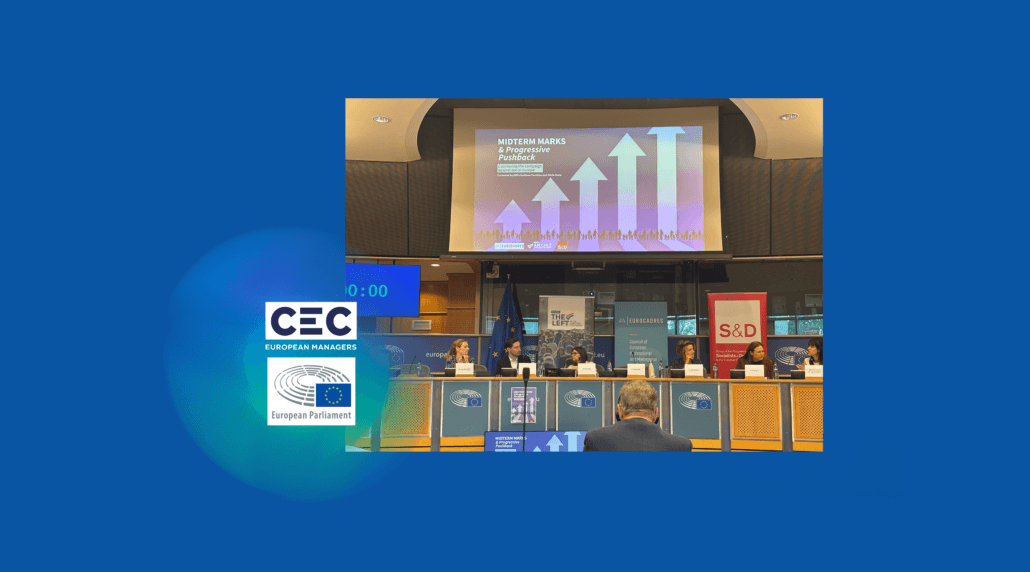
CEC European Managers was present at the European Parliament as policymakers, social partners, researchers and civil society representatives debated the direction of Europe’s social and economic agenda at the midpoint of the current institutional mandate.
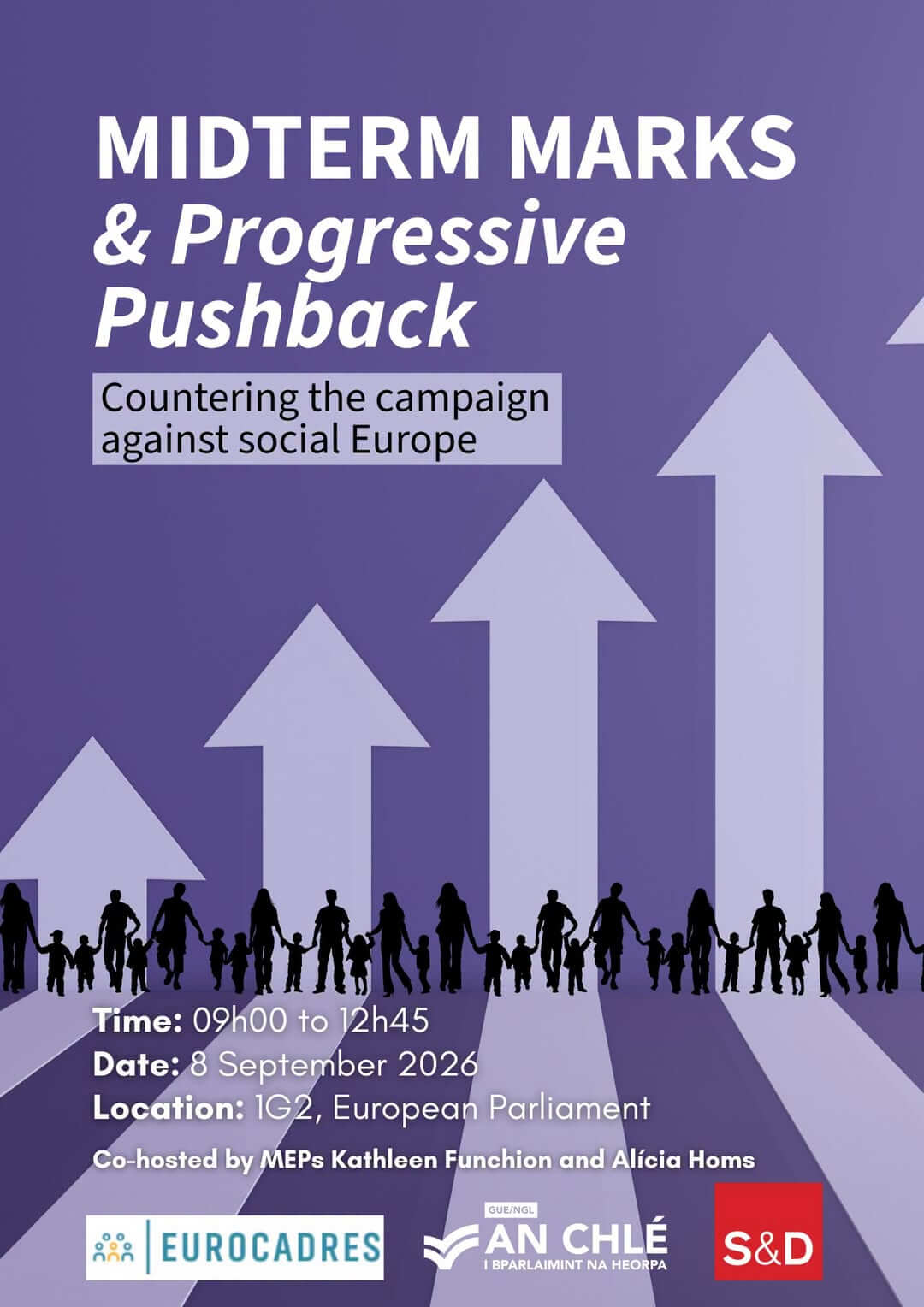
The event, “Midterm marks & progressive pushback – Countering the campaign against social Europe”, took place at the European Parliament on 8 September and brought together Members of the European Parliament, trade union representatives, experts and civil society organisations to assess developments since the beginning of the mandate and discuss the choices ahead for Europe.
CEC European Managers was invited to participate by its sister organisation, Eurocadres, which also represent managers and professionals in the European Social Dialogue. Pere Vilanova, CEC European Managers’ Communication Officer, attended the event on behalf of the confederation.
From competitiveness and regulatory simplification to Artificial Intelligence and democracy at work, a central question ran throughout the discussions: how can Europe strengthen its economic position without weakening the social model and workers’ protections that remain one of its defining strengths?
The programme reflected this debate directly. A first panel examined the relationship between competitiveness and the current simplification agenda, while a keynote by Professor Isabelle Ferreras explored democracy at work and workers’ participation. The final session turned towards the political and social choices that will shape the remainder of the European mandate and the years ahead.
AI is a political technology. It’s a technology of government. It’s going to govern the life of people at work and even outside work.
Isabelle Ferreras

Competitiveness cannot mean a race to the bottom
Competitiveness has become one of the central concepts guiding European policymaking. For CEC European Managers, strengthening European competitiveness is both necessary and indispensable.
Europe needs investment, innovation, higher productivity, stronger skills and companies capable of competing globally.
But competitiveness and social progress cannot be treated as opposing objectives.
Europe will not become more competitive by making its workers less protected. Sustainable competitiveness must go hand in hand with quality jobs, workers’ rights, social dialogue and responsible leadership.
Itxaso Domínguez de Olazábal, EDRi stated “Anything that happens in the digital world never stays in the digital world and is translated into your everyday lives, especially when it comes to the human rights impacts.”
This position reflects CEC European Managers’ wider approach to the current European debate.
Managers are directly responsible for translating strategic decisions into reality inside organisations. They are expected to deliver transformation, maintain performance and support their teams at the same time.
As CEC President Maxime Legrand has previously underlined, social dialogue should therefore not be considered an obstacle to faster decision-making, but a condition for legitimacy, efficiency and stability.
The Parliament discussion also reflected concerns about whether “simplification” risks becoming synonymous with lowering social, digital or employment safeguards.
Participants questioned whether Europe can build a successful competitiveness strategy if it pursues economic efficiency separately from the quality of work and the protection of fundamental rights.
“The European sustainability model could be a competitive advantage over the US, for instance,” said Maria van der Heide, Head of EU Policy at ShareAction, and she added “Competitiveness is often translated into less rules for business, less rules also for the financial sector, but maybe we have understood competitiveness wrong.”
The answer lies in finding a European model of competitiveness: one built around skilled people, innovative companies, social partnership and high-quality employment rather than competition based primarily on lowering standards.
Artificial Intelligence brings the debate directly into the workplace
Artificial Intelligence was one of the clearest examples of why that balance matters.
During the discussions, AI was presented not simply as another technological product but as something increasingly capable of shaping how decisions are taken inside companies: how work is organised, how workers are monitored, how performance is assessed and how responsibilities are distributed.
Professor Isabelle Ferreras notably argued for greater worker involvement in decisions surrounding AI deployment and described the need for workers to have a meaningful voice in shaping the technologies governing their working lives.
Her intervention also connected this debate with the emerging European discussion around quality jobs and the future regulation and governance of Artificial Intelligence at work.
Managers are simultaneously users of AI systems, implementers of organisational change, decision-makers responsible for their teams and workers themselves. Even when decisions are influenced by algorithms, managers often remain accountable for their consequences.
CEC has therefore consistently argued that innovation must be accompanied by transparency, appropriate skills, human oversight and clear responsibilities.
From political debate to practical solutions: AI MANAGE
CEC European Managers is not only contributing to this debate through representation and advocacy.
Through AI MANAGE, the EU-funded social partner project coordinated by CEC European Managers, managers’ and employers’ organisations are working together to turn these policy discussions into practical solutions for workplaces.
AI MANAGE is developing a cross-sector framework for the responsible implementation of Algorithmic Management, Artificial Intelligence and Generative AI. It combines research and real-world evidence with common principles, practical guidance, tools and training for managers, companies and social partners.
AI MANAGE is intended to help bridge the gap between European AI regulation and what actually happens when Artificial Intelligence enters the workplace.
Over the coming months, expert work, social partner exchanges and project activities will progressively provide practical input on responsible AI implementation.
This work has already started with the presentation of the AI Panel during a dedicated workshop in Copenhagen hosted by Lederne Denmark.
The AI MANAGE outcomes will feed into CEC’s dialogue with the European Commission, European Parliament and other institutional actors as they shape the next generation of European approaches to AI and algorithmic management at work.
The project’s broader programme will subsequently deliver evidence-based guidelines, an AI Management Toolbox and dedicated training resources, grounded in research and testing rather than abstract assumptions about how AI operates.
This practical dimension is particularly important at a moment when the European debate is moving from whether AI should be adopted towards how it should be governed and implemented.
Managers as part of Europe’s answer
The discussions at the European Parliament confirmed that Europe’s competitiveness, technological transformation and social model are becoming increasingly interconnected.
CEC European Managers will continue to advocate for an approach in which economic transformation strengthens rather than undermines the people responsible for delivering it.
Europe needs to be competitive. It also needs to remain European in the way it competes.
The event featured contributions from Kathleen Funchion MEP, Alicia Homs Ginel MEP, Kevin Flynn, Estelle Ceulemans MEP, Louise O’Reilly TD, Itxaso Domínguez de Olazábal, Maria van der Heide, Isabelle Ferreras, Nayla Glaise, Konstantinos Arvanitis MEP, Benedetta Scuderi MEP, Rudi Kennes MEP and Jim Sheridan.

